
People who come to acting classes with some ambition — even modest, realistic ambition — often arrive with a fairly underspecified picture of what they are working toward. They want to act. They find the work interesting. But "acting" covers an enormous range of practices, contexts, and skill sets, and the differences between them matter more than is generally acknowledged in introductory training contexts.
This article examines three broad categories of acting work — stage, screen, and voice — with the aim of helping students understand what distinguishes them, where their training overlaps and diverges, and how an understanding of these distinctions might help clarify where to focus development.
Stage: the live encounter.
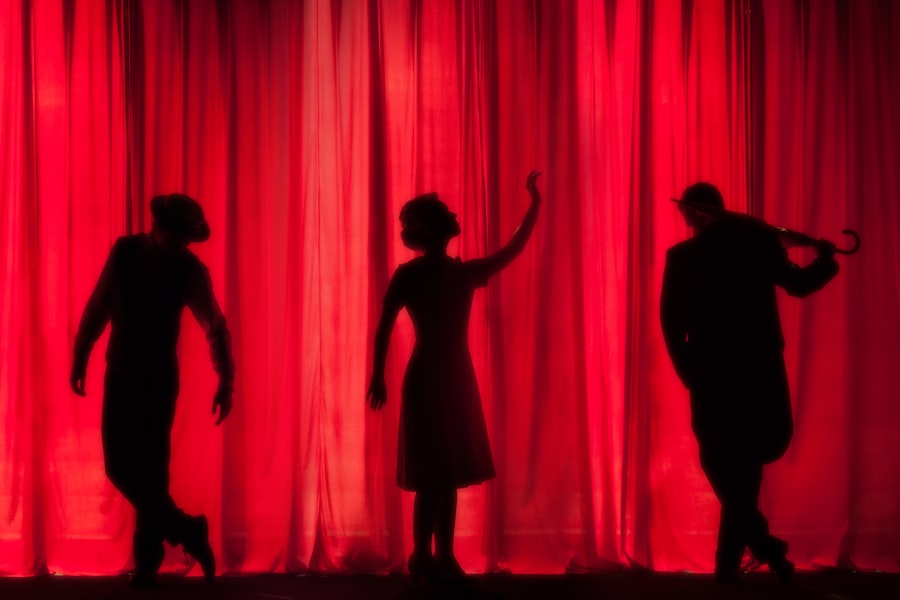
Theatre is the oldest and, in some respects, the most technically demanding form of acting work. The stage actor must fill a space — sometimes a large one — with the physical and vocal presence of their character, while remaining genuinely present in the scene, responsive to what actually happens in each performance, and consistent enough across many performances to hold a coherent dramatic arc.
The technical demands of stage acting are shaped by the fact that everything is live, collective, and irreversible. There is no editing, no second take, no close-up to correct an imprecise moment. What happens in front of an audience is the work — it cannot be adjusted or improved after the fact. This irreversibility is both the terror and the particular freedom of theatre. Actors who have worked primarily in other mediums often describe the feeling of performing live as uniquely clarifying: the stakes are real in an immediate and undeniable way.
Projection, clarity, and the capacity to sustain a character across the full arc of a long production are skills that are developed specifically for the stage. The size of the performance — how much physical and vocal energy is required to reach the back row while still appearing truthful — varies enormously with venue. An actor who has worked only in studio theatre will face a genuine technical challenge in a larger house, not because their acting is wrong, but because the scale of delivery required is different.
The relationship to text in theatre.
Theatre remains a primarily text-based medium, and the actor's relationship to language is central in a way that it is often not in screen work. This is particularly true in classical theatre, where the structure of the verse, the length of the speeches, and the particular demands of Jacobean or Elizabethan language require specific technical preparation.
Contemporary theatre has complicated this relationship considerably. New writing encompasses work that is densely verbal and work that is largely physical, work that depends on psychological realism and work that is explicitly theatrical in its conventions. But even in the most unconventional contexts, the theatre actor tends to have a relationship to spoken language that is more foregrounded than in other acting contexts.
Screen: intimacy and precision.
Camera acting is fundamentally different from stage acting, and the differences go deeper than scale. The most important is this: the camera records, with remarkable precision, the quality of attention that an actor brings to a scene. An actor who is genuinely thinking — who is actually listening, actually responding, actually in the moment — looks different on screen from an actor who is executing a pre-decided interpretation of a scene. The camera does not reliably reveal the difference in a theatre. On screen, it almost always does.
This premium on genuine internal process — on being rather than doing, in the formulation often attributed to Meisner — is one of the reasons that acting for camera is sometimes described as the most demanding form of the craft. There is nowhere to hide. The technical accomplishment of stage projection and vocal clarity is not available as a form of covering ground. What is on the screen is what is actually happening in the actor's experience.
This does not mean that screen acting requires no technical preparation. It requires a great deal — particularly in understanding the camera's relationship to scale, spatial awareness, and the practical demands of working on a film or television set. Continuity, hitting marks, working in short non-sequential takes, and managing the considerable disruption of a production schedule while remaining emotionally available are all technical skills that are specific to screen work and are not developed in a studio training context.
Preparation and the screen actor.
One of the consistent surprises for stage actors who transition to screen work is the degree to which preparation must shift. Stage rehearsal is a collective, cumulative process: the arc of the work is built progressively through repeated exploration with the same collaborators. Screen work more often involves arriving at readiness independently — knowing your material deeply, having done the emotional and analytical preparation in advance, and being ready to produce genuine work in a compressed and unpredictable context.
This requires a particular kind of discipline. The actor who is only able to prepare effectively through the collective rehearsal process will struggle on set, where the conditions that support that process are typically absent. Building the capacity to prepare independently, and to enter a scene already alive rather than needing time to find the work, is one of the distinctive challenges of screen acting training.
Voice work: the invisible performance.
Voice acting — work done entirely through the voice, whether for animation, audio drama, audiobooks, video games, commercial voiceover, or documentary narration — is a discipline that is often overlooked in general acting education and that has become increasingly significant as audio production has expanded.
The complete absence of the body in voice work creates both constraints and freedoms. The constraint is obvious: all the information that an actor typically communicates through physical presence, gesture, and expression must be communicated through vocal quality alone. Rhythm, pace, pitch variation, breath, resonance, and the specific character of individual speech sounds carry the entire weight of characterisation and emotional truth.
The freedom — which experienced voice actors often describe as enormous — is the absence of the physical self-consciousness that is so significant a factor in stage and screen work. In a recording booth, alone with a microphone and a script, an actor is freed from the question of how they look. What this reveals, somewhat paradoxically, is the degree to which acting is fundamentally an internal process. The voice follows the thought, the image, the impulse. When the body is removed from the equation, the relationship between imagination and expression becomes unusually clear.
Technical demands of voice work.
Voice acting is technically specific in ways that general acting training does not fully address. The relationship between text and vocal delivery in voiceover work — particularly commercial and corporate contexts — has its own conventions and pressures. Animation voice work requires a different kind of physical and emotional commitment than most actors expect: the performance must be bigger, clearer, and faster than in most other acting contexts, without losing truth.
Microphone technique — understanding proximity, breath noise, sibilance, and the way that recorded voice behaves differently from projected stage voice — is a practical skill that is best learned through specific technical instruction and a great deal of practice in front of a microphone.
What the three share.
Despite their differences, stage, screen, and voice work share a common foundation: the capacity to be genuinely present in an imagined situation, responding truthfully to what the situation demands. This capacity — which is what good acting training primarily develops — is the transferable core that makes it possible to move between different acting contexts without starting from nothing.
The technical skills specific to each medium can be learned. The foundation of genuine presence, responsiveness, and the willingness to be specific and honest in the moment is harder to develop and takes longer. Which is one of the arguments — not the only one, but an important one — for training that begins with the foundation rather than with the medium-specific technique.
Making choices about where to develop.
Students who want to develop toward a specific medium should, at some point, pursue training that is specific to that medium. Stage actors will benefit from production experience, from working in different kinds of theatrical space, and from extended rehearsal processes. Screen actors will benefit from camera-specific training, from working on short films, and from developing the particular discipline of independent preparation. Voice actors will benefit from studio time, technical microphone training, and a great deal of text work.
But the starting point — for all three — is the same: an understanding of what acting involves at its most basic level, and a developing facility with the internal and external processes that allow a human being to be genuinely present in a situation that is entirely imagined.